
Finding People in Hawaiʻi Records
A Hawaiʻi residents directory joins distinct records kept for different public purposes: property files show parcel owners and tax facts, court files show parties and open cases, historical books may place a name on a street, and voter records expose only fields state law makes public. None lists everyone living on the islands.
Start a Hawaiʻi residents directory search with a known detail and test it in a second source. Spelling, an owner's mailing address, and gaps in dated directories can mislead; an island, date, middle name, spouse, or Tax Map Key can distinguish people with the same name. Record the office, search terms, and date checked for follow-up.
- For an address, identify its parcel and TMK in the county map or property portal.
- Check the assessor record for the owner name, site address, mailing address, and sales-history clues.
- Search the statewide Bureau of Conveyances index by TMK, party name, or known document number.
- If the person agrees, have them confirm their own voter record through the state self-check.
- Use eCourt Kōkua or a library collection only for the question each source can answer.
- If a public record is not online, contact the office that keeps it and describe the record you need.
Hawaiʻi's Record-Keeping Offices
Hawaiʻi has no county recorder of deeds. The Department of Land and Natural Resources Bureau of Conveyances keeps land instruments statewide; county real-property offices maintain assessment records and maps. The Judiciary keeps case information, elections offices handle registration, and the Department of Health issues vital certificates. State Archives and the Hawaiʻi State Public Library System preserve historical material.
Route each question to the custodian for that record type, then use the island's county or circuit as needed. Kalawao is a county-equivalent without an ordinary service counter, so a statewide office may be the right neighbor-island starting point.
Hawaiʻi State Archives
364 S. King Street
Honolulu, HI
Weekdays, 9-4; retrieval ends at 3:30
Hawaiʻi Vital Records
Statewide custodian, OHSM
In-person office move announced for October 2026
Check the current visit address
Office of Elections
Statewide registration help
County election divisions serve each island
808-453-VOTE / 800-442-VOTE
Hawaiʻi Property Rolls and the TMK
County assessment systems connect a place to land records, with different search modes. Honolulu qPublic supports owner, address, and TMK searches; Maui lists location address, parcel/TMK, owner, map, and sales modes. Hawaiʻi County's parcel map shows geometry and TMK, while Kauaʻi also uses TMK as its parcel key.
Honolulu separates the site address from a taxpayer mailing address and may show a deed number in sales history. Maui's public documents add ownership-history and field books through 1987. These are clues about recorded ownership, not occupancy lists.
The Honolulu property-search screen shows the owner, address, and TMK routes. Hawaiʻi County's real-property and TMK page explains its parcel-to-tax-office handoff.
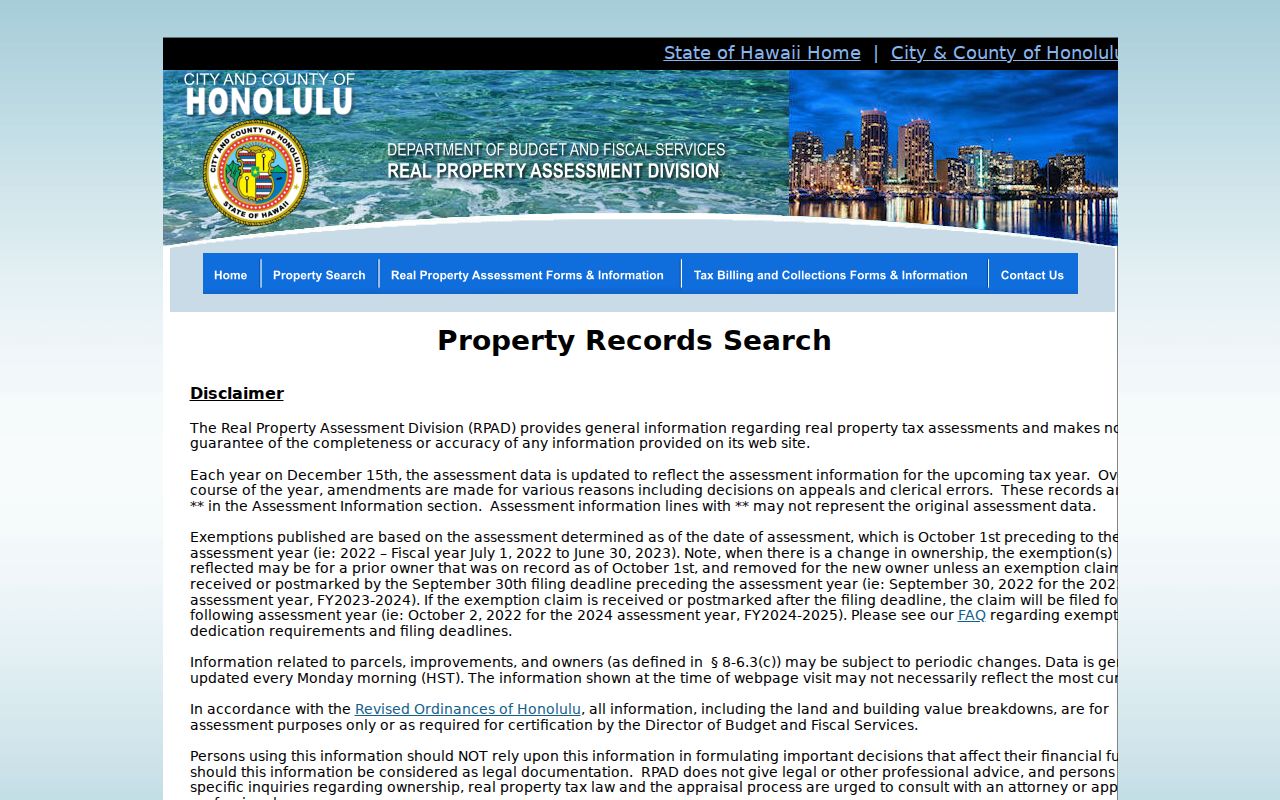
On Oʻahu, copy the TMK before moving from a map to a tax result or recorded instrument.
| Search field | Use in a Hawaiʻi property search |
|---|---|
| Site or location address | Find the parcel from its physical street address; units and abbreviations can change results. |
| Owner name | Honolulu and Maui document name search; try a business or trust name when relevant. |
| TMK or parcel ID | Carry one parcel from GIS into the assessor and statewide deed index. |
| Map or sales search | Maui lists map and sales modes; Honolulu records can expose a deed number in sales history. |
Maui County's property portal gives a separate island example of location, owner, map, and sales search controls.
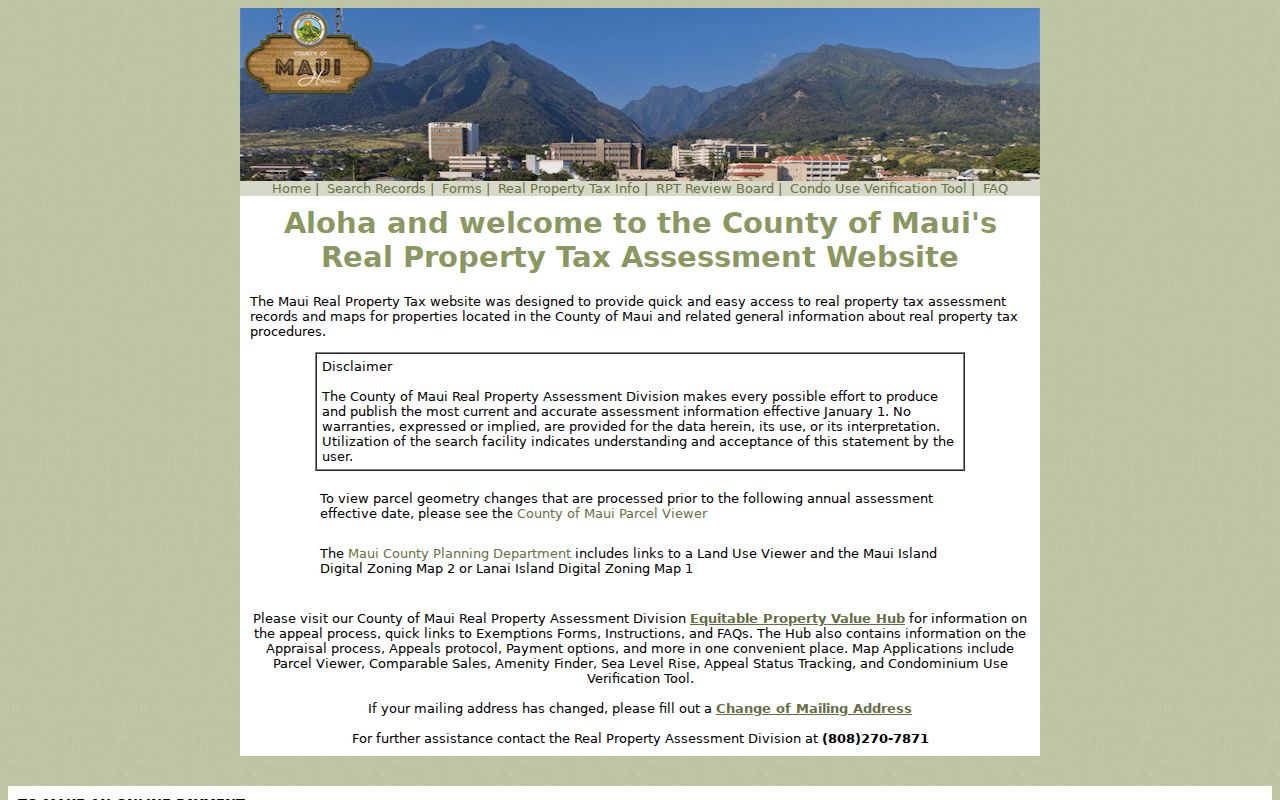
After finding a TMK in Maui's map or address search, carry that key to the public-documents records rather than treating the map as a people list.
Note: A TMK identifies land for record searches, but a map layer is not a legal survey or proof of occupancy.
What Hawaiʻi's Voter Roll Reveals
Hawaiʻi law does not turn voter files into an open name-to-address directory. Under HRS §11-97, the public fields are a voter's full name, district or precinct, and status. Other information in the registration affidavit is confidential except for election or government purposes. A residence address can receive added protection in qualifying safety cases.
The Office of Elections tool is for a voter to check their own registration. Online confirmation requires a Hawaiʻi driver license or state ID and Social Security number. A person without those credentials can use a paper application through a county elections division or call the voter line with the requested identity details. County offices also handle proof-of-registration requests and election questions.
The text of HRS §11-97 spells out which fields are public and which remain protected. A successful self-check is not permission to treat the voter roll as a household list.
The Online Voter Registration tool shows the current self-check and address-confirmation route.
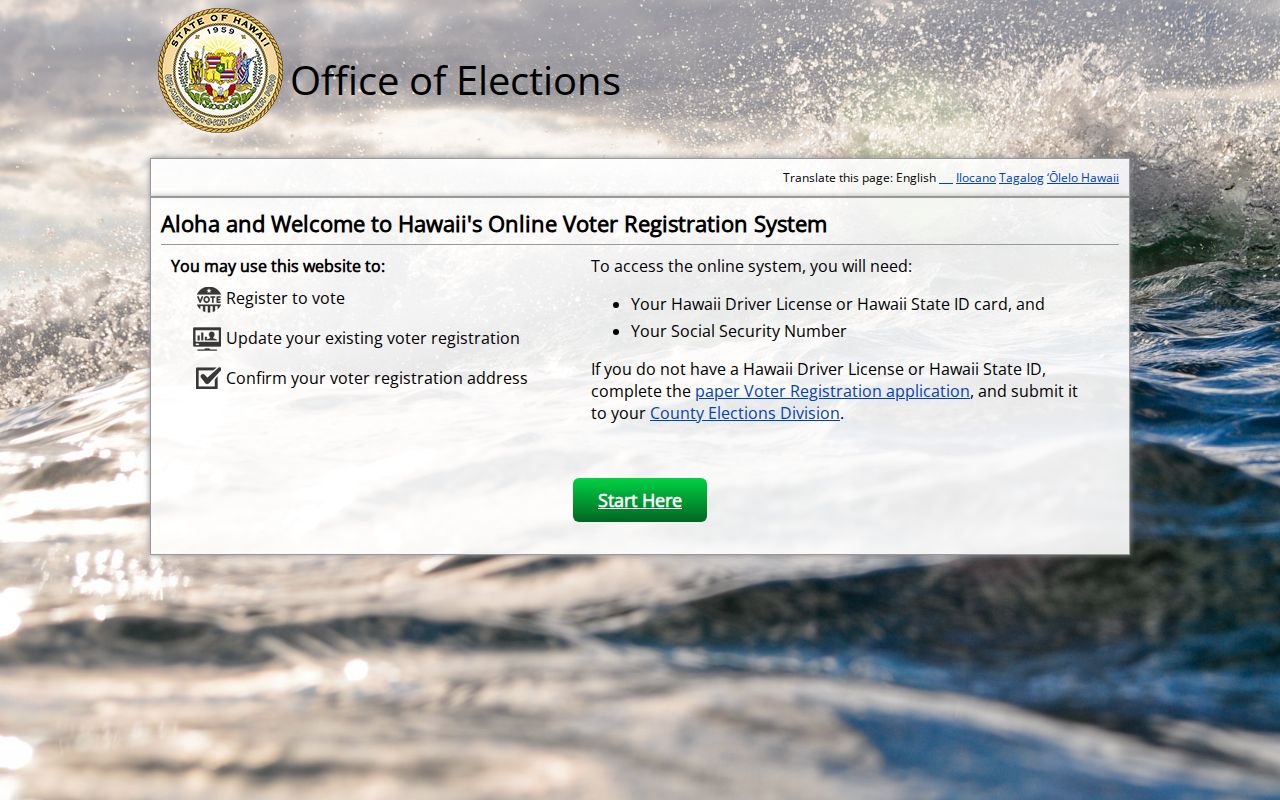
Use this path to confirm a record with the voter, not to infer that a person lives at a particular address.
Use Hawaiʻi's eCourt Kōkua Carefully
eCourt Kōkua covers public traffic, district, circuit, family, Land Court, Tax Appeal, appellate, and Supreme Court case information. Party Search includes name, person, company, and Party ID routes. Person Search can use first and last name, with partial and phonetic options. A filing-date search can narrow a case hunt, but its date range is limited to 60 days.
A result can show a case ID and type, status, filing date, court and location, parties and aliases, events, docket entries, and offenses in criminal matters. The Judiciary warns that a name match is not positive identification. Compare the party role, island or circuit, dates, and related cases. Basic case details are free; document downloads cost $3 each or $0.10 per page, whichever is greater. Older traffic, district criminal, and appellate cases fall outside the stated online coverage cutoffs, while sealed and juvenile matters are not public.
The Judiciary's eCourt Kōkua access page explains current case types, limits, and document options.
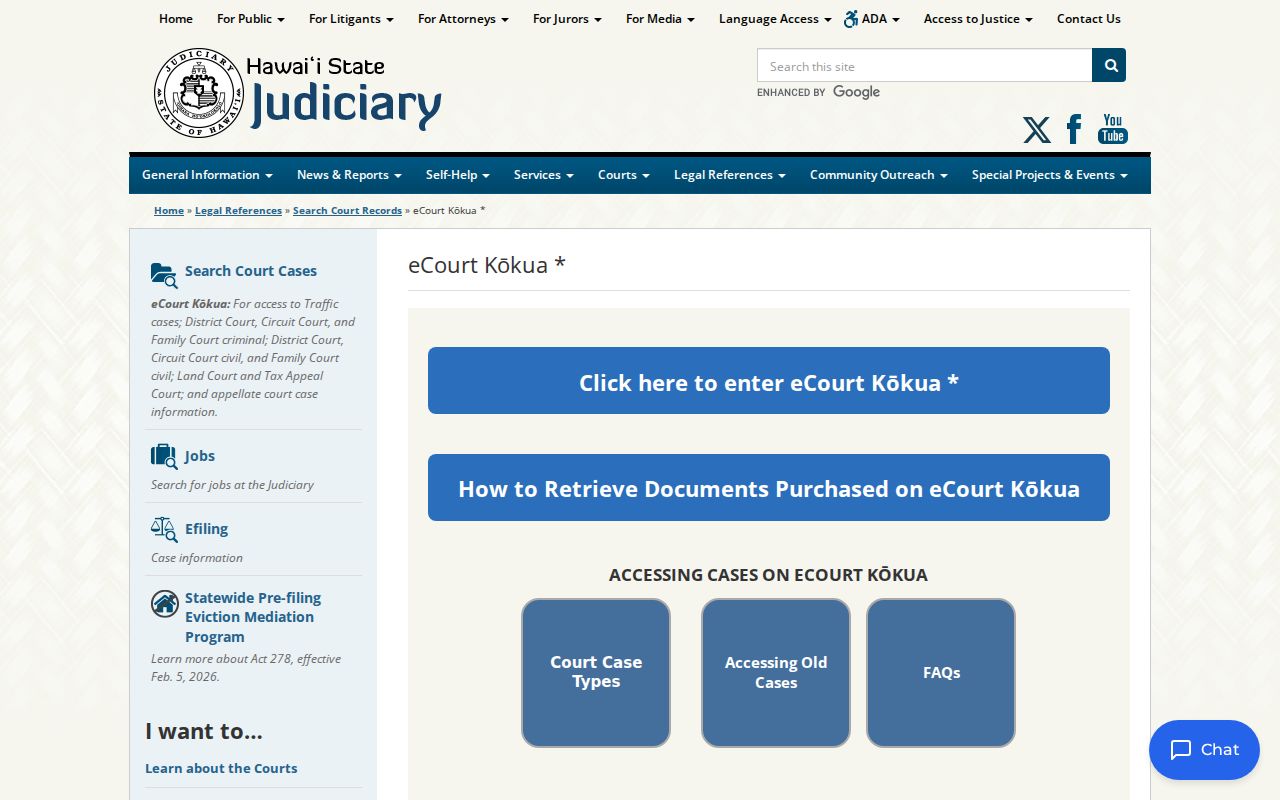
If the case is not online, a courthouse public terminal or the clerk's copy process may be the next step; private or sealed material stays restricted.
Note: A case-party result documents a court record, not a complete biography or proof that two same-name people are the same person.
Hawaiʻi Vital Records and the 115-Year Rule
The Department of Health's Office of Health Status Monitoring controls birth, death, marriage, and civil-union certificates statewide. Certified copies are limited to people with a direct and tangible interest under HRS §338-18 and the department's rules. The rule covers records within 115 years; older events may use the genealogy process, which still requires the official form, supporting material, and payment.
Birth and marriage orders start at $10 for the first copy plus the administration fee; death orders use the same first-copy base and added-copy fee. A letter of verification reports the facts supplied by the requester rather than uncovering unknown details. Online, mail, and in-person routes exist, but the current form controls what to send and which eligibility proof is required.
For a divorce after February 1, 2026, contact the circuit court that handled it. DOH announced that the vital-records office is moving from 1250 Punchbowl Street to City Financial Tower, 201 Merchant Street, Suite 100, with completion expected October 1, 2026. Verify the current location before a visit or mailed request because the transition may slow service.
Note: A genealogy index can help identify a date or place, but it does not make a modern certificate an unrestricted record.
Today's Hawaiʻi Resident Record Sources
Current records are organized by purpose, not by a master roll of Hawaiʻi residents. The table shows what each public source can confirm and where its limits begin. An owner's tax record, a court party line, and a voter-status field are different kinds of evidence, so keep them separate when you compare names.
| Record set | What it can confirm | Keeper | Access route |
|---|---|---|---|
| Property assessment | Owner and tax fields linked to a parcel | County real-property office | Public county portal; fields vary |
| Deed index | Parties and details of recorded instruments | State Bureau of Conveyances | Account search; document image may cost |
| Voter record | Full name, district/precinct, and status | Office of Elections and counties | Own-status check; other fields are restricted |
| Public case | Party role, dates, case status, and docket events | Hawaiʻi Judiciary | Basic online details; document and clerk routes |
| License or business filing | Credential status or a filed business affiliation | DCCA PVL or BREG | Official public search; verify portal status |
A Hawaiʻi residents directory search works best as a set of checked links between records. A tax result can lead to a deed number; a court search can lead to a clerk's copy process; a name in an old book can be compared with a newspaper notice. Each custodian decides what may be shown and certified. Together, these records make a practical Hawaiʻi residents directory path, but never a complete list of everyone in the state.
The Hawaiʻi Bureau of Conveyances
The Bureau of Conveyances keeps deeds, mortgages, liens, plats, condominium records, and other land instruments statewide. RecordEASE searches individual or business names, document numbers, TMKs, and legal-description fields, with Regular System and Land Court filters.
Registration is required; account searches are free and image orders are paid. The Bureau does not state a universal online starting year. Pre-1976 records may require a written or in-person search; supply known book/page, document number, party, or instrument clues. The stated written-search charge is $35 per document plus $10 processing.
Older document-number formats change over time. A sale-history number can lead to a prior grantor or grantee, who becomes the next search term. Hawaiʻi uses one deed repository for all islands.
Search the Bureau of Conveyances by party, TMK, instrument number, or legal fields, then confirm image access and fee before ordering. Its official pre-1976 guidance explains the written request path and charge.
Hawaiʻi's UIPA Request Path
When a needed public record is not in a portal, request it from the agency that holds it under Hawaiʻi's Uniform Information Practices Act, HRS chapter 92F. A written request should name the agency, describe the record in a reasonable way, include contact details, and state a preferred delivery method. The requester does not need to give a reason.
The agency may release the record, redact protected parts, deny access under a statute or court rule, ask for clarification, or explain that it does not keep that record. If an agency asks for clarification or prepayment, OIP says to respond within 20 business days or the request may be treated as abandoned. The official guide lists search at $2.50 per 15 minutes, review and segregation at $5 per 15 minutes, and copies at $0.05 per page, with an initial $30 waiver and a possible public-interest waiver up to $60.
The Office of Information Practices request guide gives the steps and fee rules. It is a guide to the law, not the custodian for land, election, court, or health records.
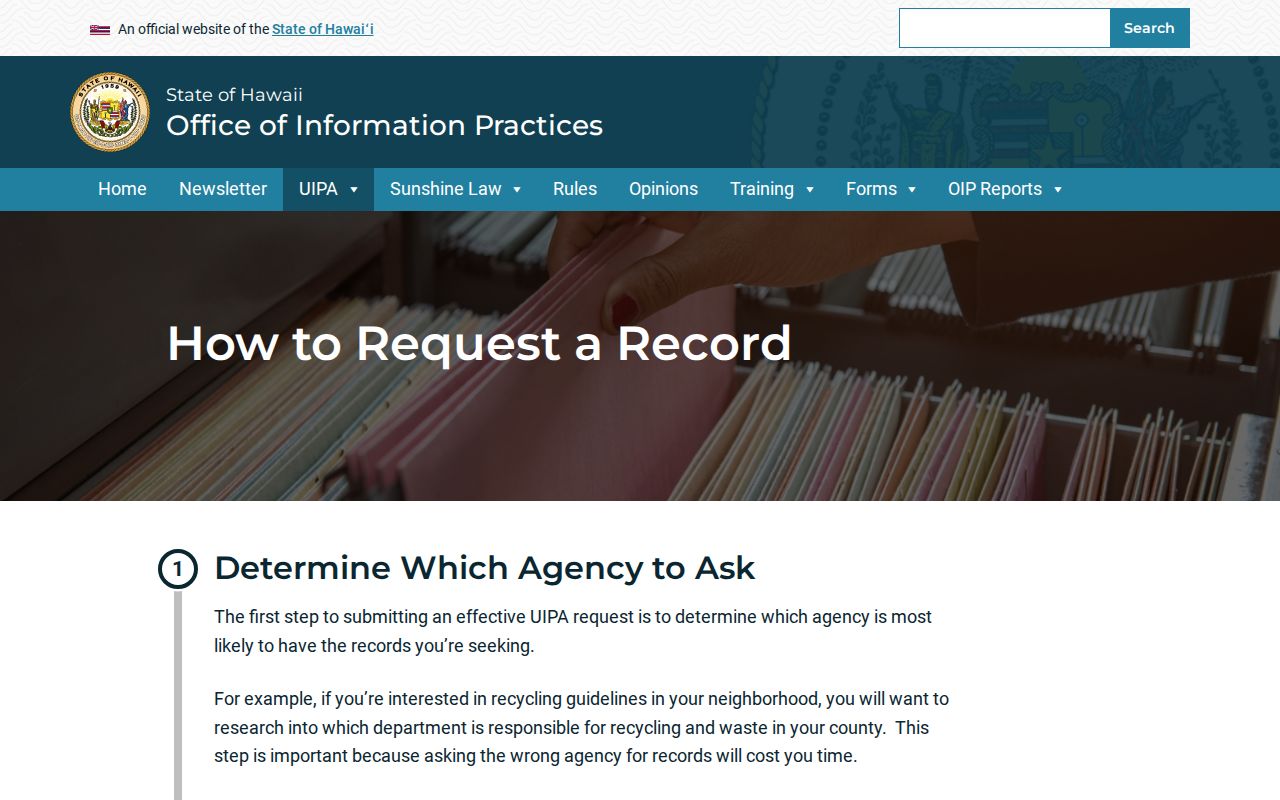
The model form shows how to identify an agency and describe a record before a custodian searches its files.
- Identify the office that created or keeps the record.
- Describe the date range, record type, name, parcel, or case number that narrows the search.
- Ask for a copy or inspection and give a way to receive the response.
- Reply to a clarification or prepayment notice within the stated period.
Note: UIPA opens government records by presumption, but it does not override a specific privacy law, sealed-case rule, or protected-address program.
Hawaiʻi License and Business Records
A professional license or business filing can confirm a public affiliation, but it does not establish a person's current address. The Department of Commerce and Consumer Affairs Professional and Vocational Licensing Division covers 52 professions and vocations through its boards and programs. Public results can show status, original license date, expiration, and discipline when that information is available.
Business Registration Division files cover entities and trade names. Their records can include filings, registered agents, officers, and business addresses in submitted documents. The public search and document route is changing: a July 2026 notice says services are moving to a new portal and expedited handling was temporarily unavailable. Start from the current BREG information page before using an older saved form.
The PVL search and license information can verify a state credential. Read a license result as evidence about the credential named, not as a complete identity match or a resident list.
Hawaiʻi's Historical Resident Directories
Honolulu and Oʻahu have a deep printed-directory trail. State Archives links selected Polk/Husted scans from 1880 through 1924, while the Hawaiʻi State Library, State Archives, and UH Mānoa hold additional print, microfilm, and image collections. Island of Hawaiʻi directories and old telephone books help bridge gaps, though no one run covers every town and year.
For Oʻahu books from 1908 onward, use the street index to find an address, then move to the alphabetical pages for a name and any printed household details. Earlier volumes may require a name-first search. Each directory is a dated snapshot. A person can move, change a name, use a different spelling, or fall outside a volume's coverage. The dedicated Hawaiʻi city directory collection page lists the year runs and reading steps.
The digital shelves also include telephone books, business directories, community publications, and newspaper indexes. UH's Hawaiian Collection can be especially useful where a name appears in a language or spelling that a mainstream index did not carry. A directory is a lead to compare with deeds, census records, family notices, or other sources, not proof of a current connection.
How Hawaiʻi Began Keeping Public Archives
Hawaiʻi records cross Kingdom, Republic, Territorial, and state eras. The State Archives was established by statute in 1905; its 1906 building gathered material from scattered offices and private storage. Some earlier records therefore sit in state or circuit collections rather than a current county office.
Archives holdings include court minutes, probate, directories, maps, newspapers, census records, and genealogy indexes. The Digital Archives is in beta and is still merging older collections; a January 2026 update added indexes without putting every original page online.
| Record era | Search context |
|---|---|
| 1905-1906 | State Archives created by law and housed in its dedicated Honolulu building. |
| 1900-1962 | First Circuit minute books include several types of court records, with access depending on the item. |
| January 2026 | Archives announced added indexes while the Digital Archives continued a system transition. |
Older Hawaiʻi searches may move from a county portal to a state archive or reading-room request as spelling, boundaries, and record custody change.
Hawaiʻi ZIPs Follow Island Geography
Honolulu covers Oʻahu; Hawaiʻi County covers Hawaiʻi Island; Maui County spans Maui, Molokaʻi, and Lānaʻi; Kauaʻi County includes Niʻihau. Kalawao is a county-equivalent, not a separate USPS route.
ZIPs are mail routes, not resident indexes or city borders. USPS checks an address, city/state, or ZIP; a Census ZCTA is an approximation and may represent a P.O. box or institution. Use a county TMK for parcel work, then USPS to confirm delivery.
A postal city can differ from county, island, or ahupuaʻa labels. Check the ZIP page's island table before treating a mailing name as a neighborhood boundary.
Protecting Hawaiʻi Addresses from Disclosure
Some people take steps to keep a residence address out of ordinary public view. Hawaiʻi's Address Confidentiality Program, administered by the Department of Law Enforcement, gives eligible survivors a substitute address and mail-forwarding service. The actual address is protected under HRS chapter 801G. Voter residence-address confidentiality is also available for qualifying safety or privacy circumstances.
These protections matter when reading a missing address or an incomplete public record. A gap does not show that a person moved or that an agency made an error. Do not try to work around a privacy rule or republish details that could put someone at risk. For a family or property question, stay with the public records intended for that purpose and ask the custodian what it may disclose.
The Hawaiʻi Address Confidentiality Program describes eligibility, substitute-address use, and mail forwarding.