
Hawaiʻi City Directory Collections
Hawaiʻi does not have one continuous city series. Honolulu and Oʻahu have the broadest run, while State Archives, library, university, and family-history shelves preserve different years and formats. This coverage map names the known collections without treating gaps as missing households. Check a catalog entry or the printed title page before citing a volume, since the exact copies held can vary.
| Collection | Years | Where Held | Access |
|---|---|---|---|
| Polk and Husted Honolulu/Territory directories | Holdings vary by individual volume | Hawaiʻi State Archives, State Library, UH Mānoa | Archive research copies and catalog links |
| Digitized Honolulu/Territory volumes | 15 listed groups, 1880–1924 | UH Mānoa eVols | Scanned books and page images online |
| Oʻahu printed directory runs | Guide identifies 1871–1924; mixed materials from 1869 onward | State Library, UH Mānoa, State Archives | Print, microfilm, and online copies vary |
| Island of Hawaiʻi directories | Examples: 1913–1928/29 and 1939–40 | Archives, UH, FamilySearch, libraries | Locate the cited volume by town and year |
| Telephone directories | Oʻahu, 1894–2001, with gaps | Honolulu and Hawaiʻi State Libraries | Microfiche, print, and later volumes |
| Community business directories | Examples: 1934; 1937–38 | UH Mānoa Hawaiian Collection | Digital collection and special-collection access |
Polk/Husted holdings include alphabetical names, address listings, and classified business sections. The digitized set names 15 year groups, not every year between 1880 and 1924. A gap in that scan list is a gap in this online run only; ask a library or archive about print or microfilm before concluding that no local directory exists.
Check the State Archives Polk/Husted holdings list before choosing a volume.
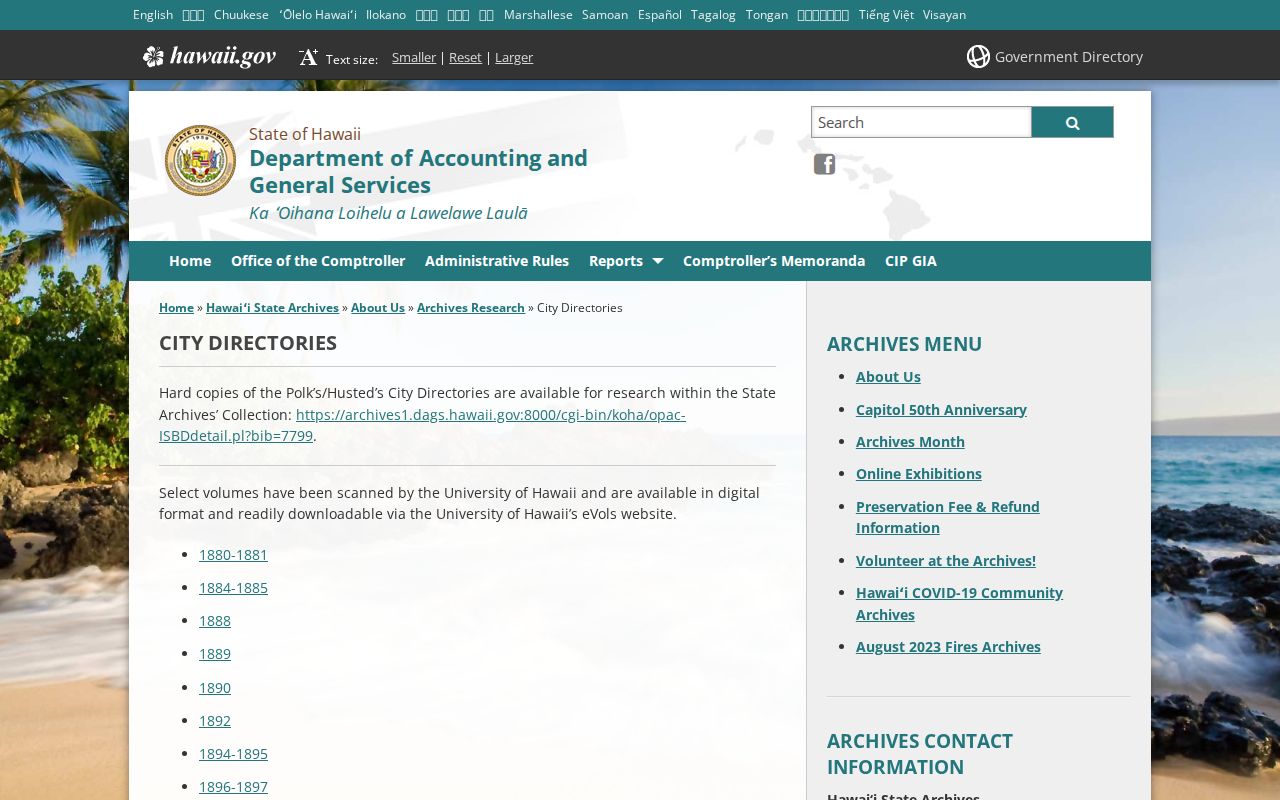
The listed scans show which years are online and when a library or archive visit may be needed.
Hawaiʻi City Directory Scans at UH
The State Archives page links Honolulu and Territory volumes scanned by UH Mānoa. Listed year groups are 1880–81, 1884–85, 1888, 1889, 1890, 1892, 1894–95, 1896–97, 1898, 1902, 1903–04, 1904–05, 1905–06, 1910, 1913, and 1924. Read the title page: a volume's title year need not be a perfect calendar-year count of residents.
For a direct scan, use the UH Mānoa eVols repository and follow the matching directory record to its PDF or page images. The State Archives also keeps hard copies for research. The two routes solve different access problems: eVols is useful for checking a page remotely, while the physical copy can supply a volume or page omitted from a digitized selection.
Open the UH Mānoa eVols Hawaiʻi directory collection to browse a scanned book and its page images.
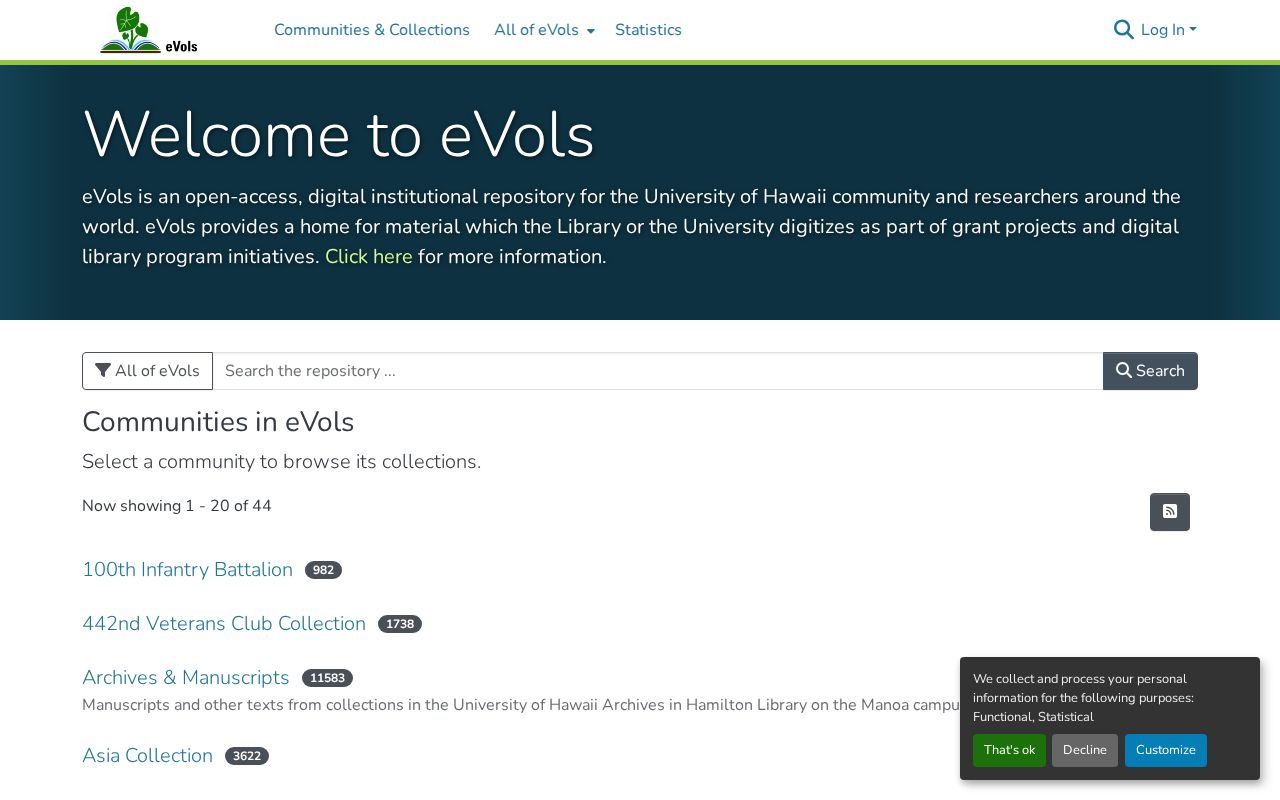
The scanned volume lets you inspect the printed page and its own title or index before recording a name.
For in-person use, State Archives is at 364 S. King Street, open weekdays 9–4; retrieval ends at 3:30. Register daily, show ID, use lockers, and keep materials in the reading room. Check its public-use rules before a visit. Hawaiʻi State Library reference staff can check local holdings and transfers at 808-586-3621 on Oʻahu or 1-800-390-3611 on neighbor islands.
Hawaiʻi Island Directory Holdings
Oʻahu's record does not stand in for the whole state. The Historic Hawaiʻi Foundation cites Island of Hawaiʻi printed editions for 1913–1928/29 and 1939–40, covering Hilo, Kona, plantation towns, and other communities. These are examples, not a complete annual series. Search by town or district as well as surname.
Check catalogs and ask State Library, Archives, UH, or FamilySearch staff which copy is available. The Historic Hawaiʻi Foundation guide describes mixed print, microfilm, and online holdings. Record the printed locality and island, since a place-name match alone does not identify a person.
Reading a Hawaiʻi Directory Entry
Scans are page images, not database rows. A complete transcribed entry and verified abbreviation key were not recovered, so the table is an inspection checklist, not a sample transcription. Check the page legend before expanding a mark and record the title, year, and printed page.
| Name | Surname and given name; note household or spouse wording exactly as printed. |
|---|---|
| Spouse or household note | A spouse or family notation may follow a name; the format can vary by volume. |
| Occupation | Record the listed description as printed when present; it is not proof of identity by itself. |
| Address | House number and street; some editions distinguish a residence or boarding notation. |
| Other marks | Possible owner/non-owner, widow, subscriber, or cross-reference notation; confirm in that volume's key. |
- Criss-cross directory
- A section ordered by street and address rather than by a person's surname.
- Householder index
- A name-ordered route into the page where a listed household appears.
- Abbreviation key
- The volume's own guide to short forms and symbols. The exact key for a selected Hawaiʻi entry remains unverified, so do not expand an unclear mark from another year.
If a mark is unclear, quote it as printed and ask the holding library for that edition's introductory pages.
Telephone Books and Hawaiʻi Directories
Telephone books add tighter date checks for subscribers, but they do not list every household. Honolulu Public Library and Hawaiʻi State Library hold an Oʻahu microfiche run from 1894–1928 with gaps, Mutual Telephone books from 1929–53, Hawaiian Telephone books from 1954–79, and GTE volumes from 1980–2001. Other-island books are also held. The publisher spans help narrow a change between directory editions, though an absent name can simply mean there was no listed phone subscriber.
Use a phone book to test a year, not to replace the main directory. Keep the island, town, and street with the name, and compare address spelling across consecutive volumes. The Hawaiʻi State Library's genealogy resources guide is a route to local indexes and microfilm. Staff help is available in person, by phone, and online; the Hawaiʻi & Pacific Section can check local holdings and place a hold or transfer request.
A missing listing means only that the person is absent from that subscriber record, not that they left the island or died.
Hawaiʻi Directory History in Dates
Established by statute in 1905, Hawaiʻi State Archives gathered records dispersed among Kingdom, Republic, and Territorial offices. Its history calls the 1906 building the first U.S. structure built solely for public archives, a reminder that older names may cross government registers, print, microfilm, and digital catalogs.
- 1869 onward: mixed Oʻahu city-directory holdings are described in the local home-history guide.
- 1871–1924: the guide identifies Oʻahu city directories in this span.
- 1880–1924: UH eVols links 15 digitized Polk/Husted year groups, with gaps.
- 1908: the home-history guide says to use the street index to locate a name, then check the alphabetical entry.
- 1907 and earlier: search backward by a known name; an address-only path may not be available.
These are guide dates, not proof of annual publication. Digital Archives is in beta; added indexes do not put every image or island series online.
Census Pairings for Hawaiʻi Households
A directory may show a yearly address or listing, while a census gives a less frequent household snapshot. Pair a directory year near a census year, then compare names, ages, family links, district, and address rather than expecting the sources to match field for field. Federal schedules through 1950 are available under the 72-year release rule; 1940 opened in 2012 and 1950 in 2022. Hawaiʻi State Archives also preserves local census series for 1866, 1878, and 1890, with island and district coverage varying.
- Write the directory year, town, street spelling, page, and exact name form.
- Find the nearest census schedule and note the household members and district.
- Compare the next directory edition for a move, changed name, or altered street number.
- Return to the archive series description before treating a local census as island-wide.
The two records have different units: one is a publisher's annual or near-annual list; the other is a household enumeration at set intervals. A gap between them is a research interval, not evidence that the family vanished.
Community Names in Hawaiʻi Directories
Plantation migration shaped Hawaiʻi's names and institutions. UH Mānoa's Hawaiian and Pacific Collections preserve Hawaiian-language newspapers, community publications, directories, and plantation records tied to Chinese, Portuguese, Japanese, Okinawan, Puerto Rican, Korean, and Filipino communities. English indexes may spell a name differently, so try the printed form, plain-ASCII, ʻokina, and macron variants.
The collection exhibit identifies a 1934 Hawaiʻi Chinese Business Directory and a 1937–38 Japanese Business Directory. They list community organizations and businesses, not all households, but may supply a spelling, association, or town to test in another source. FamilySearch also lists a 1975 Honolulu Polk/Husted sample of 2,221 pages, a later-period bridge.
Pair such sources with church registers, newspapers, yearbooks, or the Archives genealogy guide. An organization listing is not proof of a current address.
Tracing Hawaiʻi Families Through Directories
Cite each year separately. From 1908, use the street index, then check the alphabetical listing; for 1907 and earlier, search by name. A changed number, spelling, or island can break the trail.
For a later family link, the FamilySearch Hawaiʻi Board of Health marriage index covers 1909–1989 and reports bride and groom, age, date and place, and parents for indexed entries.
Use the FamilySearch Hawaiʻi marriage-index search to inspect its name and event fields.
The index can help test a family connection, but it is a separate record series and does not replace the printed directory entry.
- Choose an available directory year close to the event or family date.
- Record the printed entry and its page, including uncertain marks without guessing.
- Compare earlier and later years, then pair a nearby decennial census.
- Search the State Archives genealogy guide for birth, marriage, and obituary notices, and check library newspaper indexes.
- Use an obituary, cemetery index, probate file, or deed as a separate identity check.
HSPLS lists Honolulu Advertiser (1856–2010), Star-Bulletin (1893–2010), Star-Advertiser (from June 2010), Maui News (from 1922, with gaps), Hawaiʻi Tribune-Herald (from 1923), West Hawaiʻi Today (from 1969), and The Garden Island (from 1902). The Advertiser/Star-Bulletin print index covers 1929–94; later years use the Hawaiʻi Newspaper Index. The HSPLS newspaper guide lists print, microfilm, and online routes.
For a recent record or address chain, use the separate Hawaiʻi resident lookup workflow to test a name against current official indexes. This historical shelf explains what an old directory can show; it does not establish who lives at an address now.