
Hawaiʻi Resident Lookup Coverage
A single-source match rarely answers more than one question. County property records identify owners and parcels; court pages show parties in public cases; credential sites confirm licenses. They are not complete resident lists. Use each result as a lead, then compare a second field or source.
| Record | What It Can Confirm | Where Held | Access |
|---|---|---|---|
| Assessor / tax roll | Owner, parcel, tax fields | County RPA portals | Public fields vary |
| Recorded deed index | Grantor/grantee and land instrument | State Bureau of Conveyances | Online; pre-1976 by written request |
| Voter record | Your registration and address | OLVR / county election divisions | Self-confirmation only |
| eCourt Kōkua | Party in a public case, dates, status | State Judiciary | Basic details free; documents may cost |
| Vital indexes / certificates | Eligible birth, marriage, or death event | DOH, Archives, libraries | Certificate access restricted |
| Probate / estate file | Estate, heir, or representative | Judiciary; historic Archives | Case and sealing rules apply |
| Business / license record | Entity filing or state credential | BREG / PVL | Public search; copies by request |
| Obituary / cemetery index | Death notice, burial, family link | Libraries, Archives, UH, papers | Historic range varies |
Start with a parcel/TMK, case number, or event date if you have one. For every address on a street, use the Hawaiʻi street directory workflow.
Verify a Hawaiʻi Resident
List known name forms before searching. Hawaiʻi records may keep or omit ʻokina and macrons, or use a transliteration variant; names may change through marriage. A same-name hit needs a match on date, island, relative, address, or case role.
- Note the full name, middle initial, alternate or former name, and likely island.
- Use a known parcel/TMK, date, case number, or entity name as an anchor. Ownership does not prove occupancy.
- Compare court party role, circuit, dates, aliases, and related cases.
- Check a second source and record the citation and any gap.
- Request a certified copy only if eligible or authorized.
- Docket
- The court's list of filings, events, and actions recorded for a case.
- Index vs. image
- An index is a searchable pointer or field summary; an image is a scan of a source page or document, and may require a separate purchase.
- Certified copy
- A copy issued and authenticated by the custodian under its rules, distinct from a screen view or ordinary photocopy.
Hawaiʻi Resident Search Fields
eCourt Kōkua covers district, circuit, family, Land Court, Tax Appeal, and appellate cases. Its May 2026 redesign moved controls; Person Search still requires first and last names. Phonetic and partial modes are available, and a filing-date search cannot exceed 60 days.
| Portal Field | Input | Rule or Useful Detail |
|---|---|---|
| Party Search: Person Search | First and last name | Both required; Phonetic Search and Partial Search are options |
| Party Search: Name Search | Name fields | Person, company, and party-ID subtabs are available |
| Company / Party ID | Company name or party ID | Required for the selected search; party ID returns associated cases |
| Filing dates and Case Type | Optional date pair and dropdown | Narrow a party result by court matter and period |
| Case Search | Case ID or listed case number | Other fields include application, arrest, TCT, OTN, SID, and filing date |
| Filing Date Search | Court type, location, room/division, case type, dates | Date range may not exceed 60 days |
| Upcoming Hearing | Case ID or court/location, island, courtroom, dates | Time range is optional |
| Vehicle Search | Plate and state, or VIN | Separate case association search, not a resident directory |
| BOC: name or document | Individual/business name, document number | Optional; search party or known instrument |
| BOC: property | TMK, legal, lot/block, land number | Optional; county/island identifiers and land type |
| OLVR: online | Hawaiʻi Driver License or State ID, SSN | Required for own registration, update, or address confirmation |
| OLVR: phone/paper | Name, address, birth date; paper form | County division fallback; 808-453-VOTE or 800-442-VOTE |
The Judiciary's May 2026 update moved eCourt controls while retaining these case-search modes. BOC search is free after account registration; purchasing an image costs money. Its written pre-1976 route costs $35 per document plus $10 processing, and needs the best known names, book/page, or document clues.
Open the Judiciary's Hawaiʻi eCourt Kōkua search page to review the current case-search entry screen.
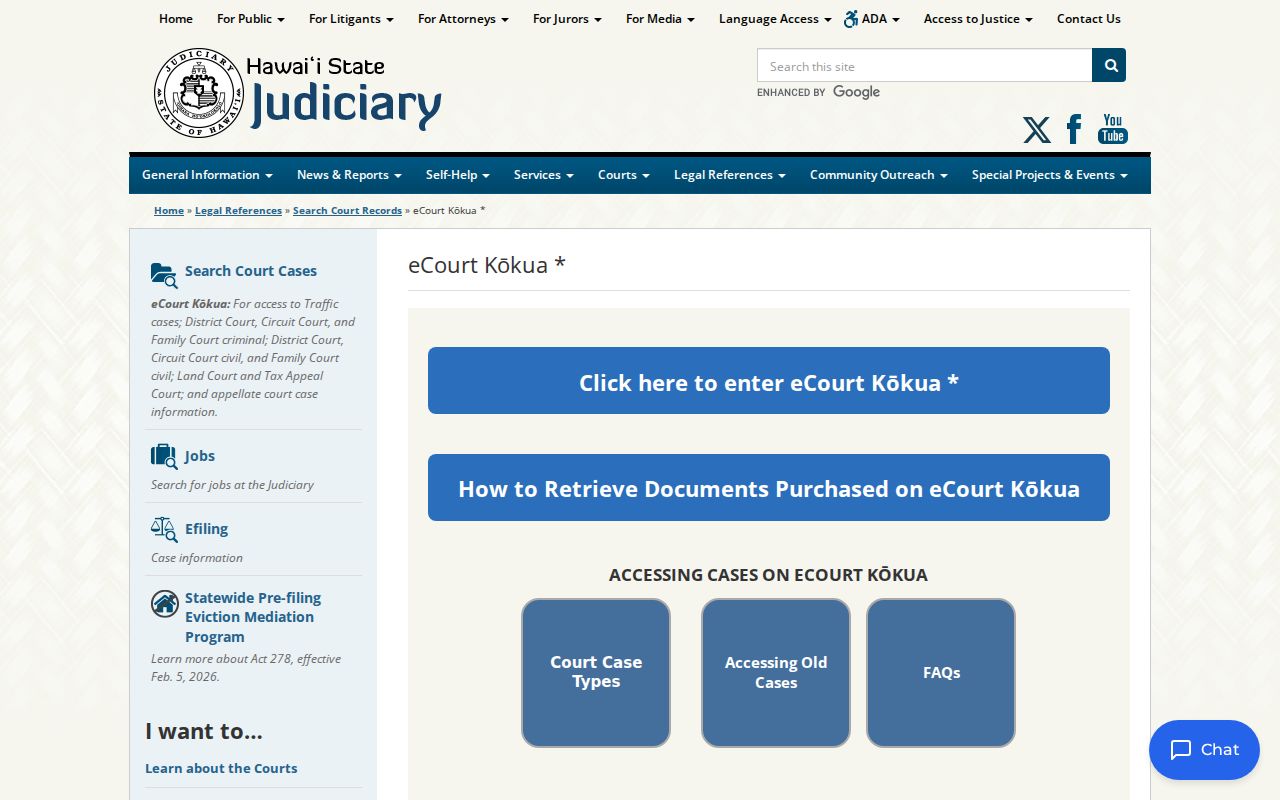
The portal warns that a name search does not guarantee a positive identity match, so check the case details before relying on a result.
Reading Hawaiʻi Court Results
A result is not the full file. Compare party, court, date, and case type. “Active” means court action is ongoing; “Inactive” means a pending case awaits an event. Sealed, juvenile, and confidential matters are not online.
| Case summary | ID and type, status, last-updated and filing dates, court, location, related cases. |
|---|---|
| Party details | Sequence, association, end date, party type and ID, name, aliases. |
| Events and minutes | Event dates, dispositions, dockets, minutes; sealed or in-camera items are masked. |
| Other fields | Bail/bond details, criminal offenses, and document purchase icons. |
eCourt omits traffic cases before November 1995, district criminal cases before August 2012, and appellate cases before September 2010. Basic details are free; documents cost $3 each or $0.10 per page, whichever is greater. Quarterly and annual subscriptions are $125 and $500. Purchases are nonrefundable and retrievable for two days. Ask the courthouse clerk or use a public terminal for offline and certified paper copies.
Hawaiʻi Voter Lookup Limits
OLVR is only for your registration, updates, and address confirmation. Its credentials, paper route, and phone fields appear in the search-field table above.
It is not a public name-to-address search. Under HRS §11-97, full name, district/precinct, and voter status are public; other affidavit details are confidential except for election or government use. Birth date, ID number, phone, email, and ballot choices are not public fields.
Use the Office of Elections OLVR page only for your own registration and address confirmation.
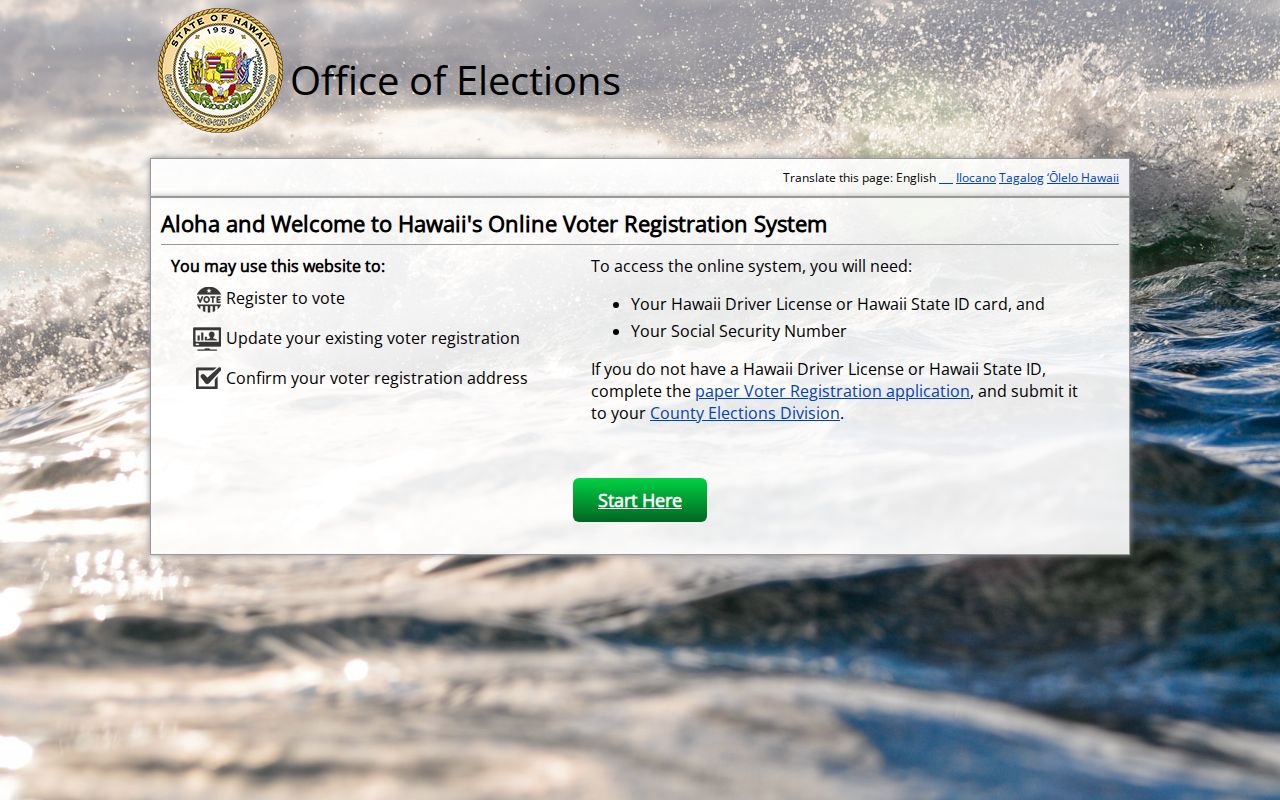
The online screen asks the voter to verify their own identity; it does not return another person's address.
County election divisions handle paper forms and proof-of-registration requests for each island.
Hawaiʻi Vital Records Access
Birth, death, and marriage certificates have restricted access. HRS §338-18 requires a direct and tangible interest for recent records, with proof of identity and authority. Eligible requesters include the registrant, spouse, parent, descendant or common-ancestor relative, authorized guardian or agent, estate representative, and listed court-authorized or special categories.
For events more than 115 years old, a genealogist may mail DOH's form, supporting records, and payment. This permits microfilm or other copies under the rule; it does not open every old certificate without limit. Archives and libraries hold some indexes or microfilm under their own rules; DOH issues the certificate. A verification letter confirms only supplied facts and the record's existence.
Use DOH's 115-year genealogy route for older records; current birth, marriage, and death requests are available online, by mail, and in person.
Review the Hawaiʻi death certificate request route and required eligibility steps before submitting an application.
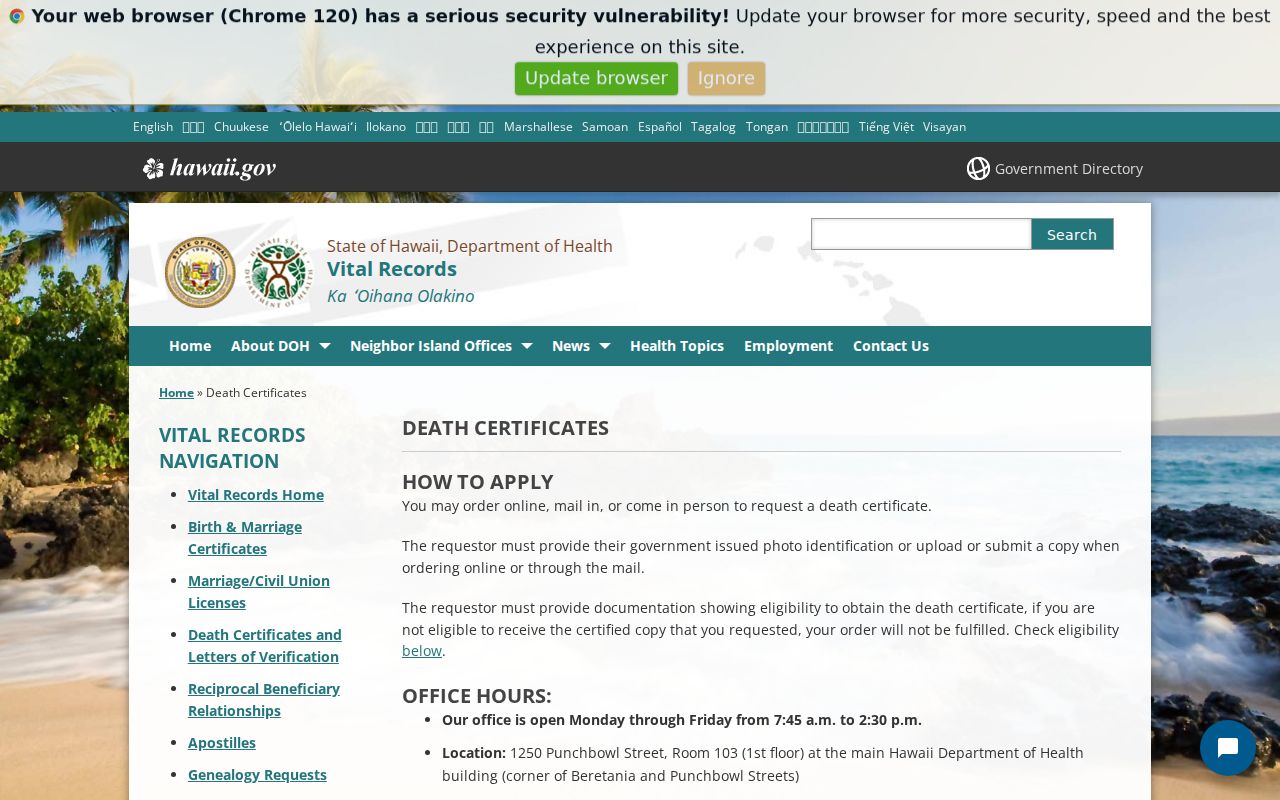
The death form asks for the person's name, event date/place, requester relationship and reason, contact details, ID, and proof of eligibility.
DOH does not run a free name-only search before an application and payment. Its August 2026 notice says the move began September 21, with completion expected October 1; verify the address before visiting or mailing and expect possible delays.
Probate Trails for Hawaiʻi Heirs
Follow the public probate docket to a petition, will, inventory, or filing naming an heir or personal representative. Ask the circuit court clerk for the case record; sealing and redaction rules still apply. Historic probate files may also be held in State Archives series, so search by court and period.
A birth-parent search uses a different route: DOH eligibility rules and Hawaiʻi's official adoption, amendment, or confidential-intermediary channels. The research review found no current exact landing page for the registry or intermediary. Start with DOH vital-record contacts and ask which route applies; a sealed adoption file is not a public lookup.
Hawaiʻi BREG and PVL Checks
BREG filings cover corporations, partnerships, LLCs, trade names, and more. Search a known entity, then check its filing for listed officers, agents, status, or address. A July 2026 notice says the portal transition is phased, so use the current state entry point.
PVL searches by license number/type, business or individual name, and some legacy screens allow partial first/last names. Results may show status, original and expiration dates, former names, and discipline. PVL oversees 52 professions and vocations. This confirms a credential, not a residence.
Search the official BREG business registry and PVL license lookup, and save the date and exact name form used because portal screens can change.
Historical Checks for Hawaiʻi Residents
For a former classmate or relative, try yearbooks, newspapers, and archive indexes. The State Archives genealogy guide lists birth notices (1850–1950), marriage notices (1850–1950), obituary notices (1836–1950), cemetery, probate, divorce, naturalization, and census materials. Hawaiʻi State Public Library System holds local indexes and microfilm and offers research help.
Newspaper and obituary coverage varies by island, title, and index date. Treat each hit as a lead, then compare a dated event or family detail with a second record.
Start with the State Archives guide or the HSPLS genealogy page for microfilm and library tools. Older directory holdings are described on the Hawaiʻi city directory page.
Legal Limits on a Hawaiʻi Resident Lookup
UIPA, chapter 92F, covers state and county records but does not override confidentiality laws, sealed court rules, juvenile limits, vital-record restrictions, or protected addresses. Write to the agency that keeps the record with contact details, a reasonable description, and preferred delivery. It may release, redact, seek clarification, deny under an exception, or say it does not hold the record.
If the agency asks for clarification or prepayment, OIP says to respond within 20 business days or the request may be treated as abandoned. The fee guide lists search at $2.50 per 15 minutes, review/segregation at $5 per 15 minutes, and copies at $0.05 per page; the first $30 of search/review/segregation is generally not charged. Agency-specific fees can differ. A request cannot force a new database or release protected information.
OIP's records-request workflow includes a model form and explains prepayment steps.
Use the OIP Hawaiʻi records-request guide to identify the correct custodian and request steps.
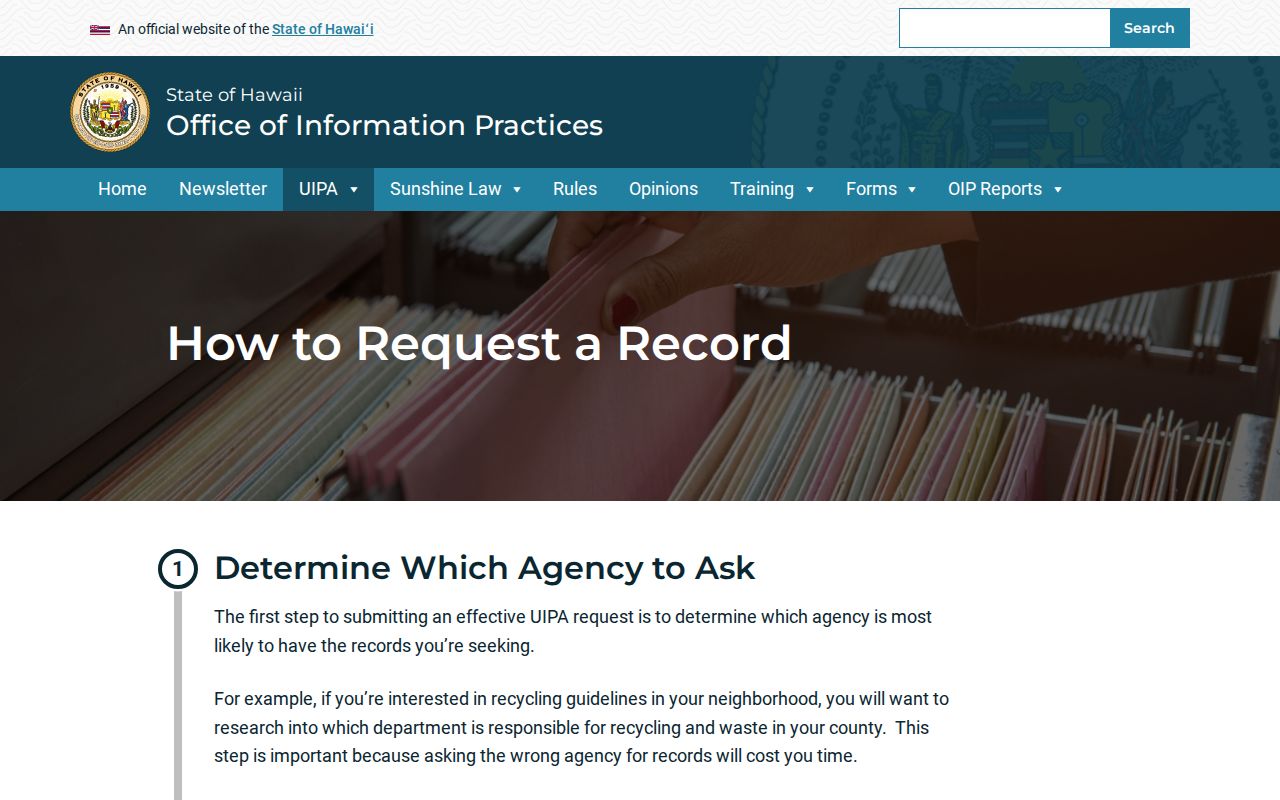
Send the request to the agency that holds the record; OIP explains access rules but does not keep the other agencies' files.
Hawaiʻi's Address Confidentiality Program gives eligible survivors a substitute address and mail forwarding; HRS chapters 801G and 11-14.5 protect qualifying addresses. An absent address may reflect those rules.
Lawful personal use. Use records lawfully. Do not publish private details or use a result to stalk, threaten, or harass; ask the custodian when a match is uncertain.
Ask the custodian how to correct an outdated record. Never repost a protected address.